Posts

The Bottom Line

Image
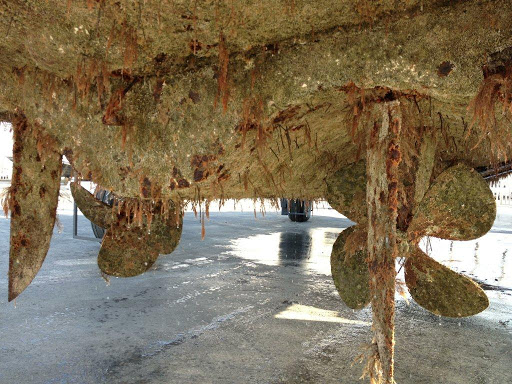
    H ere in the Crystal River area where we keep our boat, underwater fouling is minimal. This is due to the amount of fresh water we have. Our canal is "brackish" with not alot of salinity and the closer you are to King's Bay and the springs the salinity goes way down. Out to the Gulf and further south, hull bottom fouling becomes worse. Go to the Keys and the Bahamas and it is very aggressive.  Wintertime when the water is cold, the growth is minimal, but when the water warms it is alive with billions of tiny organisms ready to cling to something and start reproducing. Now that our boat is in Tampa Bay and the water temperature is moving into the 70's the growth is accelerating.  How do we combat this? The list of ways is endless but the basic method is to apply Anti-Fouling coatings. Bottom paint. There is a whole science and tons of info about anti-fouling coatings so I won't go into all of it but basically there are 2 types of paint. Hard & Ablative. Bot...
Movin’ On Up....or Down

Image
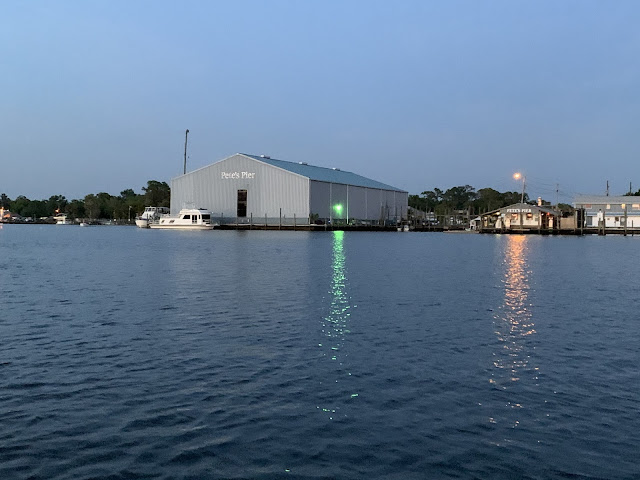
Pete’s Pier  The trip south to all our “fun” spots is a good day (8 hours).  We put out a request on some different forums for anyone looking to rent out their slip for awhile. We made contact with a boat owner in Tampa who was leaving for 6 months to head north. We emailed back & forth and decided, “let’s go for it!”. The slip is in Old Tampa Bay at the Westshore Yacht Club . It looked really cool. We spent the next month and a half getting Pau Hana ready for the new location. Westshore Yacht Club The predicted tide at our departure time was very low so we left the day before & spent the night on the hook in King’s Bay, that way we didn’t have to worry about hitting bottom. Little did I know. We had an awesome night & we were greeted by a fantastic sunrise.  We made some coffee & a quick breakfast, did our checks & motored out. Remnants from a Canaveral launch? I had a lot of confidence in a new route allowing me to cut in a little closer & shave ...

Here Comes The Sun

Image
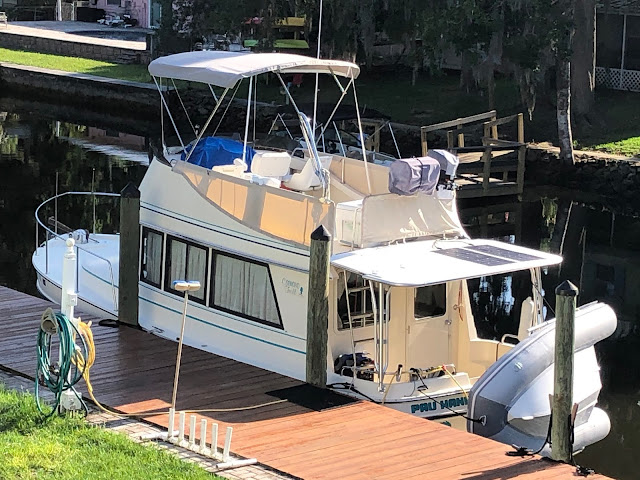
  .....and it's all right!  The rear deck on Pau Hana has a fantastic aluminum & fiberglass cover over it. The skin is a thin fiberglass panel that the previous owner used to store his Port-A-Bote. I had another idea. Since the day I saw the area I thought "Solar Panels".       A WORD OF WARNING : This is the first time I have dealt with any solar panels or installation, that said I may not have done part or any (for that matter) of this project correctly. This is just how I did it, you should do your own research to decide how to properly install any item on your boat, especially if it is electrical in nature.     There are so many choices of panels. I did find from my research that they are not all created equal and like anything else, some are better than others as they may use a better quality materials. There are basically 3 types of panels. Monocrystalline, Polycrystalline and Thin Film. Monocrystalline is the best and most efficient typ...

Dinghy Time

Image
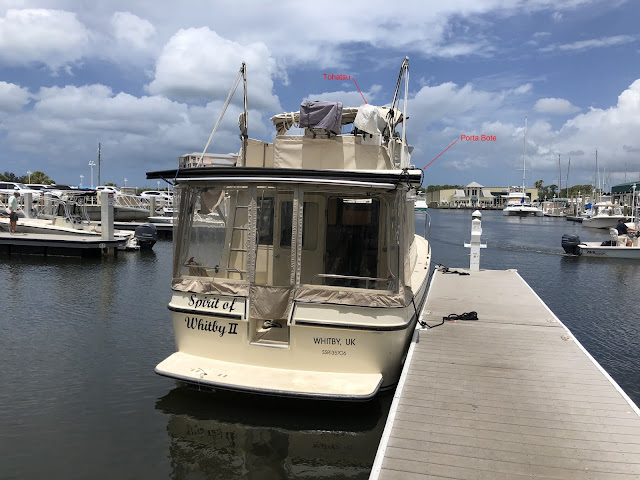
     When we purchased Pau Hana (formerly The Spirit of Whitby) it came with a 3.5 HP Tohatsu 4 stroke and a Porta Bote folding boat.   1st "Splash" Placida, FL     I had no interest in the folding boat as it was a pain to set up, so we sold it and saved the money toward a RIB.  The only issue with the Tohatsu was, the carburetor was off & in pieces and there were a few parts missing. With some research I learned that these motors are notorious for carburetor issues so no surprise that the previous owner had issues with it as well.      In looking through the motor, I had a cracked fuel tank as well.  I was able to locate a new carburetor kit as well as the tank and some new "ethanol" tolerant hoses. There is a carburetor kit that brings the HP of the Tohatsu up to 5 HP & it comes with an aluminum prop. I figured what the heck & ordered it.  I saw some discussions on line that suggested upgrading to the higher ...

AIS

Image
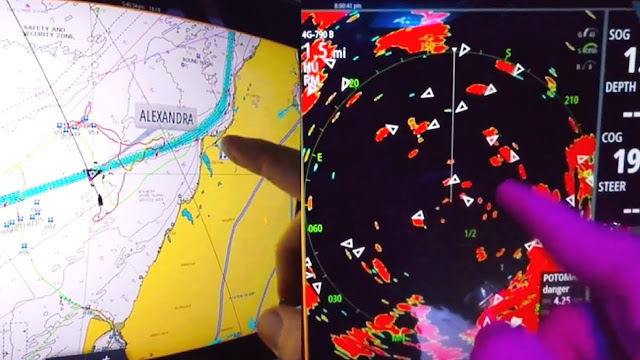
AIS Displayed on SIMRAD GO9 & Radar Overlay After reading quite a bit of information, especially on the AGLCA forum, I became pretty convinced of the importance of AIS.  The Automatic Identification System (AIS) uses transceivers mounted on the boat to supply and/or read information about ships/boats in your vicinity (VHF range) such as ship name, size, identification, position, course and speed.  The information can be viewed by boats having the system installed and provides a way for the operator to communicate with other ships without having to "guess" who they are attempting to communicate with.  The system is very handy when operating in or near areas of large ship and barge activity.  Especially on rivers where you can't see around the bend. Imagine coming around the bend in a river only to be met by a tug pushing a bunch of loaded barges. With the AIS the captain of either boat can hail the other and provide information about what they may need to pass saf...