Posts

Showing posts with the label Electronics

AIS 2 - The devil is in the Details

Image
  AIS Screenshot I failed to outsmart the marine electronics world. If you read my original AIS blog entry , I thought that by upgrading my marine VHF radio with built in AIS I would save the time, money and hassle of having to purchase and install a separate AIS transponder. Wrong....well right, sort of. With built in AIS in the VHF I could see vessels with AIS and get their info, but they can't see me with their system. That could work, but somewhat defeats the purpose of why I wanted AIS in the first place. The inland river systems are loaded with tows, barges and ships. If that mile long tow & barge is coming around one of the many sharp bends of the river, their radar will not see a vessel around the corner. AIS means not only can they see my vessel, they know the type, speed, position, direction and my vessel name, allowing them to call me by vessel name and tell me what they would like me to do upon our meeting and provide me with the same identification.  Once agai...
Battery Switch

Image
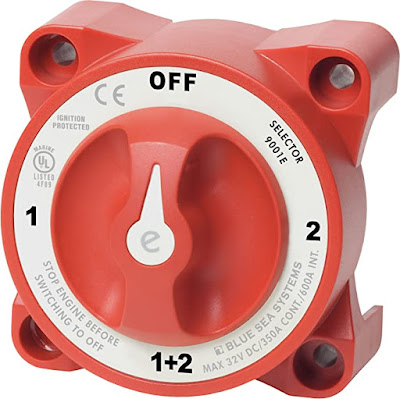
  Blue Sea System 9001E Battery Switch Pau Hana never had a battery switch for the main engine. It just seems prudent to have one in case for instance the starter stuck and the power needed to be turned off. Another issue I had was that I had no way to charge the generator battery. I did run a wire to the battery charger but that only works if the battery charger is running.  My solution was to install a 3 position switch for the engine and move the generator battery next to the Engine battery and wire that to the switch as well. The new switch would do 4 things. Allow me to shut off the engine battery Start the engine from either battery Combine the batteries for starting Charge the generator battery  First I made a Starboard bracket for the battery switch that fastened to an upright next to the existing battery.  New Battery Switch & Backer                             Next I installed 2 new G...

Battery Issues

Image
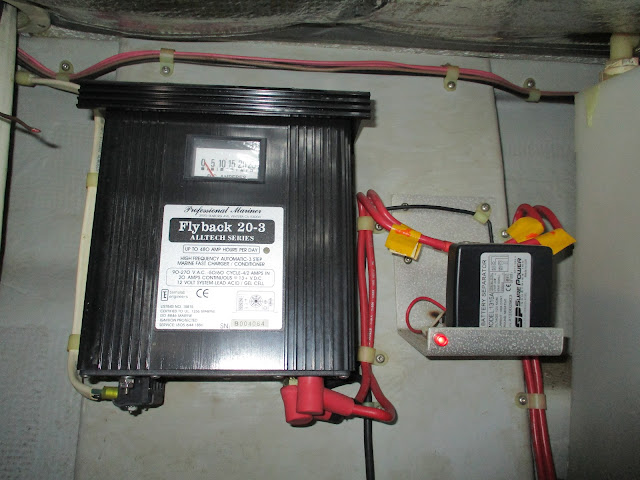
  Battery Charger & Separator What you think you have might not be what you actually have. That's what a friend of mine told me when discussing the setup in my boat...and he was right. The Camano was built with a Battery Separator. Instead of a mechanical battery switch, the separator is tied to the engine battery and the house battery bank.  The unit does 2 things. 1. Assist in engine starting:  When the engine starter is activated, the separator compares the voltage of both battery banks. If the start/engine battery is lower than the house battery bank, the Battery Separator will engage allowing the house battery to "aid" in starting. 2. Protect the starting system: The Battery Separator monitors the battery system to determine if the batteries are being charged. When the engine or house batteries reach 13-13.5 volts, indicating that charging is taking place, the Battery Separator will engage, joining the two battery banks. If the drain on the charging system by ei...

Instrument Panel - "What's going on down there?"

Image
    The instrument panel on the Fly Bridge had become ragged. The panel itself was cracked at 3 of the 4 corners and the top gauges had yellowed from 20 plus years in the elements and difficult to read. I tried to buff them out but all I could manage was a polished foggy yellow lens. The 52mm rings on 2 of the gauges were broken and the volt gauge was hanging underneath the console.      My first thought was that since I have a shop with the right tools, I could fabricate a new panel from Acrylic. I knew it would look awesome but I did some research and found that I could buy the OEM panel only  Volvo Part #860182  for less than $100. Somewhat expensive but I figured I'd spend way more time drawing and cutting it.  Way easier. The Tachometer was fine although the LED hour meter wasn't showing. The LED hour meter at the lower helm comes and goes, but I handled that with a new analog hour meter at the lower helm a few months ago.     I att...

Engine Cooling Should be Alarming

Image
 What can at the very least be a small nuisance and at the most be the nail in it's coffin disaster is a raw water restriction or flow decrease and engine overheat in a diesel engine. It can be very preventable just by constantly scanning your gauges. But it only takes a few seconds for some type of raw water flow reduction or impeller destruction to turn your engine into toast. A project I had planned from the beginning was High Temperature Alarms. I installed them on a previous boat, a Luhrs 320. I know they work like they are supposed to because not long after installing them (2 engines) my port engine must have sucked up a plastic bag or something & instantaneously the Raw Water Alarm went off. I pulled back the throttle, shifted to neutral and the alarm shut off & the engine temp dropped. At 25 mph and a butt load of seawater being cycled  through the engines, this small event could have been cataclysmic but instead it was a hiccup.  The Camano moves much slo...

The Bottom Line

Image
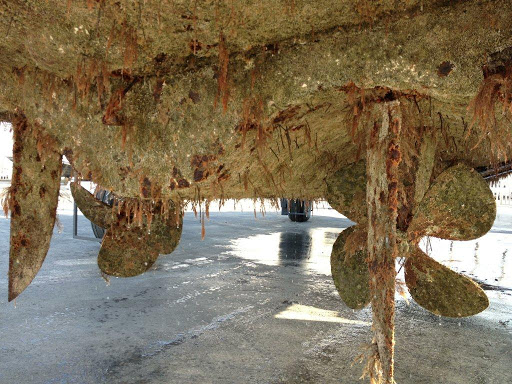
    H ere in the Crystal River area where we keep our boat, underwater fouling is minimal. This is due to the amount of fresh water we have. Our canal is "brackish" with not alot of salinity and the closer you are to King's Bay and the springs the salinity goes way down. Out to the Gulf and further south, hull bottom fouling becomes worse. Go to the Keys and the Bahamas and it is very aggressive.  Wintertime when the water is cold, the growth is minimal, but when the water warms it is alive with billions of tiny organisms ready to cling to something and start reproducing. Now that our boat is in Tampa Bay and the water temperature is moving into the 70's the growth is accelerating.  How do we combat this? The list of ways is endless but the basic method is to apply Anti-Fouling coatings. Bottom paint. There is a whole science and tons of info about anti-fouling coatings so I won't go into all of it but basically there are 2 types of paint. Hard & Ablative. Bot...